

Affiliate Disclosure
Some links on this page are affiliate links. As an Amazon Associate, we earn from qualifying purchases — at no extra cost to you. We do not buy, test, or physically handle the products we cover; our rankings come from aggregated owner reviews, ratings and expert consensus. Commissions never change our verdicts. How we rank & full disclosure.
Some links below are affiliate links. As an Amazon Associate we earn a commission from qualifying purchases at no extra cost to you — and it never changes which products we recommend or where they rank.
A large garage is an unforgiving indoor-climate problem. The bigger and less-insulated the space, the more heat you have to pour in just to keep up. An undersized unit will run flat out and still leave you cold.
The right answer depends on your power and your ceiling height. A hardwired 240V electric unit like the Comfort Zone 10,000W below is the cleanest whole-garage electric option. A gas forced-air heater moves more heat into the biggest or unwired spaces. Undersizing is the mistake owners regret most here, so lean toward more output than you think you need, and insulate the door if you can.
What types of garage heaters work for a large space?
Three categories cover most large garages: hardwired 240 volt electric forced air, plug-in 240 volt electric with a heavy-duty cord, and propane or natural-gas forced air. Infrared heaters can supplement any of these for spot warmth at a bench. They aren't built to carry a whole large garage on their own.
A hardwired electric unit like the Comfort Zone models above is the cleanest option for a cold climate garage that already has 240 volt capacity. No fuel, no venting — just a thermostat and a switch. A propane-fired forced air heater trades that simplicity for far more heat output per dollar of running cost. That matters once you're heating a genuinely large or drafty workshop.
Infrared or radiant electric panels are worth adding as zone heating aimed at a workbench. For whole-garage coverage in a large space, though, forced air — electric or propane — is what actually moves enough heat output to keep up. Brands like Mr. Heater and Modine specialize in the gas forced-air side, while Fahrenheat and Dr Infrared are common names in electric and infrared garage units.
Hardwired 240 volt electric forced air
A hardwired 240 volt unit is the cleanest option for a garage with the wiring to support it. No fuel, no venting — just a thermostat and a switch. Fan-forced output pushes warm air across the whole bay.
Propane and gas forced air
Propane and gas forced-air heaters move more heat output per dollar of running cost. They need venting and clearance, which is why they suit the biggest or unwired garages best.
Infrared heaters for zone heating
Infrared heaters add zone heating at a workbench rather than warming the whole garage. Pair one with a forced-air unit if you want instant spot warmth while the main heater catches up.
What size heater does a large garage actually need?
For a large two-car garage, plan on roughly 7,500 to 10,000 watts of 240V electric heat, or a gas unit around 50,000 BTU, assuming reasonable insulation. Poor insulation, high ceilings, or a big roller door push you toward the top of that range, or into gas.
Volume, not just floor area, drives this. A large garage with a high ceiling has far more air to heat than the square footage suggests. The recurring theme in owner reviews: people buy for the floor plan and forget the ceiling height, then find the unit can't keep up. When in doubt, size up — especially in a cold climate, where the outdoor-to-indoor temperature gap is bigger for more of the year.
Square footage, BTU and heat output
Match heat output to square footage, then adjust for ceiling height. A 50,000 BTU gas unit and a 10,000W electric unit land in the same rough heat output range for a large two-car garage.
How much does a large garage heater cost to run, and does a thermostat help?
A 240 volt electric unit at 7,500–10,000 watts draws 7.5–10 kWh per hour on full output. That's a meaningful running cost if you heat a large space for hours at a time. A 50,000 BTU propane forced-air heater costs less per BTU of heat output, but adds the price of propane or natural gas itself.
This is the trade-off behind the electric-versus-gas decision. Electric heat output is simple to budget — it's just your kWh rate times the wattage times the hours run. Gas running cost depends on local fuel prices, and burns through a 20 lb tank faster than most owners expect in a large, cold-climate garage.
A programmable thermostat that cycles the heater off once the space is up to temperature is the single biggest lever on either fuel's running cost. A garage held at a lower baseline temperature, and boosted only when you're working there, costs a fraction of one held hot all winter.
Should a large garage use electric or gas heat?
Electric hardwired units are simpler and need no venting. They suit large but insulated garages with adequate 240V capacity. Gas forced-air units deliver more heat per dollar of running cost, and suit the very largest or uninsulated spaces — at the cost of fuel, ventilation, and a more involved install.
The bigger and colder the garage, the more the economics favor gas — that's why commercial shops run gas forced-air. For a large but sealed home garage with the electrical capacity to spare, a hardwired electric unit is easier to live with. Our electric vs gas garage heater comparison weighs the two directly.
Cold climate performance: electric vs propane
A cold climate favors gas in the very largest or leakiest garages, where propane's heat output per dollar wins out. A well-insulated garage with 240 volt capacity to spare does fine on electric.
Ceiling mount or wall mounting — where should a large garage heater go?
Ceiling or high-wall mounting in a corner, angled toward the main work area, is standard for large garages. It keeps the floor and walls clear and lets fan-forced warm air circulate down and across the space. Keep the required clearances from the ceiling and combustibles the manual specifies.
Overhead mounting is why the Comfort Zone units in this list are built the way they are. Floor space in a large garage is working space, and a ceiling mount stays out of the way of vehicles and benches. Position it so the airflow sweeps the area you actually use, not an empty corner.
What does insulation cost before adding heat to a large garage?
Insulating the garage door and any exposed stud walls is almost always cheaper than buying a bigger heater to compensate. It pays back every winter, rather than once. A basic reflective or foam garage door insulation kit is a weekend project that meaningfully cuts heat loss in a large, uninsulated bay.
Heat output is only half the equation in a large garage. How fast that heat escapes is the other half. A cold climate location makes insulation even more valuable, since the gap between indoor and outdoor temperature stays wide for more of the year.
Owners who insulate the door and add basic wall insulation before upgrading their heater consistently report needing less wattage or BTU than they originally budgeted for. The workshop or garage simply holds the heat output longer. If your garage will double as a workshop you use for hours at a stretch, that insulation investment often matters more than which heater brand you choose.
Workshop insulation and heat retention
A workshop holds heat output longer once you insulate the door and walls. That often means you need less BTU or wattage than you first budgeted, in any cold climate garage.

Best for a large wired workshop or oversized garage
- Fan-forced 10,000W output on 240V
- Full-function remote and digital control
- Ceiling mount to save floor space
- Overheat protection and thermal cut-out
Why buy it: For a genuinely large electric-heated garage, this is the Comfort Zone owners point to — the 10,000W output is what warms a big bay that smaller units cannot keep up with. A common note is that it needs a heavier 240V circuit, so confirm your panel and wiring can support it before buying.

Best for the biggest garages, or one with no suitable 240V circuit
- 50,000 BTU forced-air output
- Runs on propane or natural gas
- Warms large air volumes fast
- Requires venting and clearance
Why buy it: When a garage is too big or too poorly wired for electric, the consensus favors gas forced-air — it moves far more heat into a large space for its running cost. Owners report it warms a big garage quickly; the trade-offs are fuel, ventilation, and a more involved setup than a plug-in.
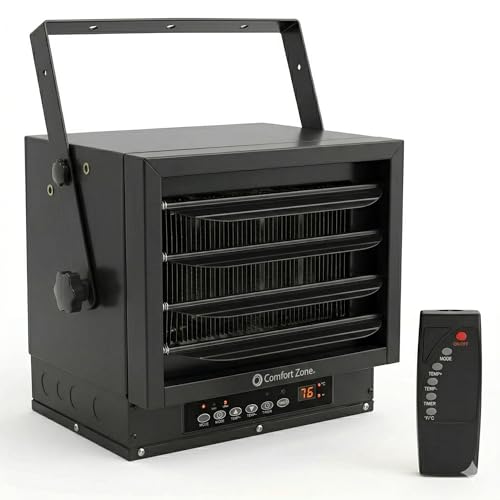
Best for a large two-car garage that does not need the top unit
- Fan-forced 7,500W output on a 240V circuit
- Ceiling mount, digital thermostat with remote
- Strong output without a 10,000W circuit
- Overheat protection and thermal cut-out
Why buy it: The 7,500W unit is the balance point for many large garages — near the output of the flagship but easier on the wiring. Owners consistently report it handles an insulated two-car garage well; a common complaint is that a very large or drafty space still wants the 10,000W model.

Best for a large garage that already has a 240V outlet
- 7500W output on 240V
- NEMA 14-50P plug — no hardwiring needed
- Adjustable thermostat
- Overheat safety protection
Why buy it: For a large garage that happens to have a welder or EV-charger outlet, this delivers high output without paying an electrician to hardwire. Owners like the flexibility; a common complaint is that the required NEMA 14-50 receptacle is not present in many garages, so verify yours first.

Best for the smaller end of large, when budget matters
- Fan-forced 5,000W output on 240V
- Three heat settings
- Ceiling mount, indoor rated
- Overheat protection
Why buy it: The 5,000W Comfort Zone is the budget option for a well-insulated garage at the smaller end of large. Owners report it keeps up in a sealed space; the honest caveat, and a common complaint, is that it is outmatched by a big, drafty, or uninsulated garage.
How we picked
We do not buy, test, or physically handle the heaters we cover. These picks come from aggregated owner reviews, manufacturer specifications, and the complaint patterns that repeat across large-garage listings — the consensus view, rather than one reviewer's take. Each links to its live Amazon listing, so you can confirm the current price and read the reviews.
See the garage heaters hub, our full best garage heaters roundup, and How We Rank for the methodology.