


Affiliate Disclosure
Some links on this page are affiliate links. As an Amazon Associate, we earn from qualifying purchases — at no extra cost to you. We do not buy, test, or physically handle the products we cover; our rankings come from aggregated owner reviews, ratings and expert consensus. Commissions never change our verdicts. How we rank & full disclosure.
Propane heaters exist for one reason: heat where there is no outlet. That single advantage buys you far more output per unit than any 120-volt appliance can produce, and it comes with a set of obligations no electric heater has — combustion byproducts, ventilation, fuel storage, and a genuinely different safety conversation. Getting the category right means being honest about where the heater will actually run.
How many BTUs do you actually need from a propane heater?
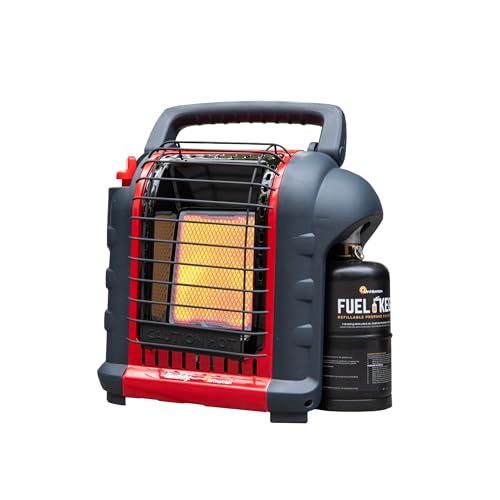
Portable radiant models typically run 4,000 to 18,000 BTU per hour, which suits a tent, an ice house, a small cabin or a work corner. Forced air torpedo heaters start around 30,000 BTU and climb past 100,000, and belong only in large, ventilated spaces.
Radiant vs forced air propane heaters
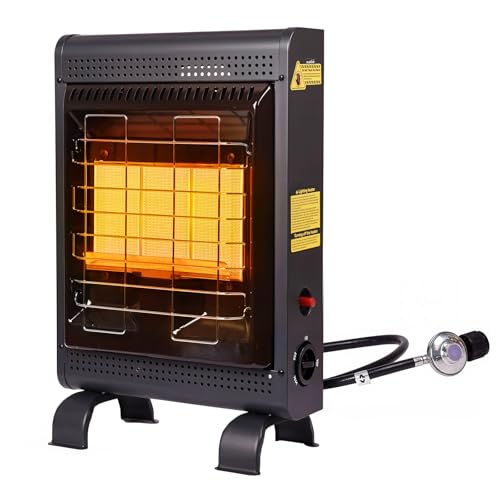
Radiant propane heaters warm objects and people directly, the way sunlight does, with no fan involved. They're the quiet, portable choice for a tent or a job-site corner. Forced air heaters instead blow a stream of heated air across a space, trading quiet for raw heat output. For a rough sense of scale, a 1500 watts electric heater produces about 5,100 BTU per hour. Even a modest portable propane unit on its middle setting matches or beats the biggest thing you can plug into a household outlet, and a construction torpedo heater is in a different league entirely. That gap is why propane dominates job sites, garages, workshops and anywhere without power — including a garage heater setup where no outlet reaches.
The mistake is buying at the top of the range for a small space. An oversized unvented propane heater in a tent or a truck cap does not just waste fuel. It consumes oxygen and produces combustion products faster than the space can handle, which is the exact condition the safety hardware exists to interrupt. Size to the space, not to the biggest number available, and run the heater on its lower setting whenever it will hold temperature there.
Which propane heaters are actually indoor safe?
Only models explicitly rated for indoor or enclosed-space use, which carry an ODS sensor — an oxygen depletion sensor — that shuts the unit down as oxygen falls. Anything sold for outdoor use only — patio heaters, forced air torpedo heaters, most construction equipment — must never be run in an enclosed space.
ODS sensor and carbon monoxide risk
Propane burns cleanly when it burns completely. When oxygen runs low it does not, and incomplete combustion produces carbon monoxide, which is odourless. It has killed people in exactly this scenario: a heater rated for a garage moved into a bedroom during a power outage, or an outdoor heater dragged into a closed tent. The ODS sensor is the difference between a unit designed for that risk and a unit with no defence against it at all — it is not an optional feature on any heater marketed as indoor safe.
Even with an indoor-rated heater, a working carbon monoxide alarm in the same space is not optional. There are state-level restrictions on some unvented models worth checking before you buy. Manufacturers also almost universally advise against running an unvented propane heater while asleep. The broader point — that combustion appliances change the air you are breathing — is covered in our guide to improving indoor air quality, and it applies here more sharply than anywhere else on this site.
How long does a propane cylinder or 20 lb tank actually last?
A 1-pound camping cylinder holds roughly 21,500 BTU, so a heater running at 9,000 BTU per hour empties one in a little over two hours. A 20 lb tank holds about 430,000 BTU — around 48 hours at that same rate.
20 lb tank vs 1-lb cylinder
Those figures are simple division and they hold up well in practice, which makes them the most useful planning numbers in the category. They also make the economics obvious. Disposable 1-pound cylinders are convenient and expensive per BTU of liquid propane. A 20 lb tank connected through a hose and regulator costs a fraction as much to refill and lasts an order of magnitude longer. Anyone using a portable propane heater regularly ends up on the hose.
One practical warning about that setup. Rubber supply hoses can shed plasticizer residue that migrates into the heater's regulator and clogs it, so most manufacturers specify a fuel filter between the hose and the heater. Owners who report a heater that will not stay lit after switching from cylinders to a bulk tank are very often describing this exact problem, and it is cheap to prevent and annoying to fix.
What ventilation does an unvented propane heater really need?
Fresh air, continuously — a cracked window or a roof vent, sized per the manufacturer's instructions rather than by feel. Unvented combustion consumes oxygen from the room and releases both combustion products and a substantial amount of water vapour into it.
Zone heating and heat output outdoors
Ventilation requirements shrink dramatically once you move the same heater outdoors. Zone heating a patio or job site with an outdoor-rated propane heater needs no ODS sensor at all, because open air replaces the oxygen a sealed tent or cabin cannot. Matching heat output to the space is still worth doing outside — an undersized unit just loses the heat race to open air — but the ventilation math that governs indoor use does not apply once walls are gone.
The moisture side is the part indoor owners are least prepared for. Burning propane produces water, and an unvented heater puts all of it into the space, which is why cabins, tents and workshops heated this way develop condensation on windows, damp bedding and, over a season, mildew on cold surfaces. It is not a fault in the heater; it is what unvented combustion does. Ventilation solves both problems at once, which is the argument for treating it as part of the heater rather than as an inconvenience.
Follow the specific opening area the manual gives rather than a rule of thumb from a forum. Be aware that many ODS-sensor heaters are only rated up to a stated altitude — the sensor is calibrated for oxygen levels at lower elevations and will cut out repeatedly above that. Owners at elevation frequently describe a heater that "keeps shutting off" when what they have is a unit doing precisely what it was designed to do.
What do propane heater owners report going wrong?
Pilots that will not stay lit, regulators clogged by hose residue, spiders and debris blocking burner ports after storage, and cold-weather performance dropping as tank pressure falls. Very little of it is element failure; almost all of it is fuel delivery. Owners of Mr. Heater's Buddy line, along with Dyna-Glo and ProCom models, report the same handful of issues regardless of brand.
Garage heater and job-site tip-over risks
A garage heater or job-site unit sees rougher handling than a cabin heater, and that shows up in tip-over reports. CSA-listed and OSHA-relevant models include a tip-over switch that cuts gas flow the instant the unit is knocked over, and owners on uneven job-site floors or gravel driveways should confirm that switch works before relying on it. Efficiency also drops when a heater is run tilted, since the burner and regulator are designed to work upright.
The tank pressure issue is worth understanding because it looks like a defect. Propane gas vaporises less readily as temperature drops, so a small cylinder in genuinely cold weather can struggle to feed a heater at full output, and the tank itself may frost over. Larger tanks have more surface area and cope better, which is another argument for the hose-and-20-lb-tank setup in winter conditions.
Storage habits account for most of the rest. Burner ports are an inviting place for insects over summer, and a heater that lit perfectly in March will refuse in November for that reason alone. A visual check of the burner, a clean hose connection and a soapy-water leak test at every reconnection covers nearly all of it. If your actual use case is a workshop or an attached garage rather than a campsite, the sizing and ventilation trade-offs are different enough that the garage heaters hub is the better starting point, and for outdoor entertaining the patio heaters hub covers the standing designs built for that job.
How should you store a propane heater and its fuel?
Disconnect the cylinder from the heater, and store tanks outdoors, upright, in a shaded and ventilated spot — never inside a house, a basement or a closet. Keep the heater itself dry and covered so insects and dust stay out of the burner assembly.
Storing a cylinder indoors is the habit that turns a well-managed heater into a hazard, and it is common in cold climates where people instinctively bring things in for the winter. A tank in a basement has nowhere to vent if a valve seeps, and propane is heavier than air, so any leak collects at the lowest point of the space rather than dispersing. Outdoors, upright, out of direct sun and away from ignition sources is the whole rule, and it is not a demanding one.
Disconnecting between uses matters as much for the hose and regulator as for safety. Leaving a hose pressurised for months is how connections take a set and begin to weep, and a soapy-water leak check at every reconnection is worth the two minutes regardless. A cover or a storage bin for the heater keeps the burner ports clear over summer, which prevents the single most common start-of-season failure owners describe in this category.
Every guide below is ranked from aggregated real owner reviews and manufacturer documentation, never from us buying and running a heater ourselves — see How We Rank for the full methodology.