



Affiliate Disclosure
Some links on this page are affiliate links. As an Amazon Associate, we earn from qualifying purchases — at no extra cost to you. We do not buy, test, or physically handle the products we cover; our rankings come from aggregated owner reviews, ratings and expert consensus. Commissions never change our verdicts. How we rank & full disclosure.
A bedroom is the one room where the quietest dehumidifier is not automatically the right one. The moisture load is modest — most bedrooms are damp rather than wet — so capacity is rarely the binding constraint. Noise is. That single fact explains both the popularity of tiny silent units and the volume of disappointment they generate, and it is where any sensible bedroom purchase has to start.
How much capacity does a bedroom actually need?
Less than most people expect. A typical bedroom is a small, enclosed space at the "slightly damp" to "damp" end of the sizing scale, so a modest compressor unit usually has ample headroom. The exception is a bedroom with an en-suite, or one on an exposed external wall.
Sizing tables work from floor area and dampness together, and a bedroom scores low on both compared with a basement. That is good news: you can buy a unit that will reach setpoint quickly and then cycle off, rather than one that grinds continuously — which matters more here than anywhere, because a unit that cycles is a unit that is silent for part of the night.
Where bedrooms surprise people is moisture generation. Two sleeping adults release a meaningful amount of water vapor into a closed room over eight hours, and an en-suite shower without a working extractor fan can dump more moisture into the space in ten minutes than the dehumidifier removes in an hour. Morning condensation on the inside of the window is the classic signature of exactly that pattern.
Are the small silent bedroom dehumidifiers worth buying?
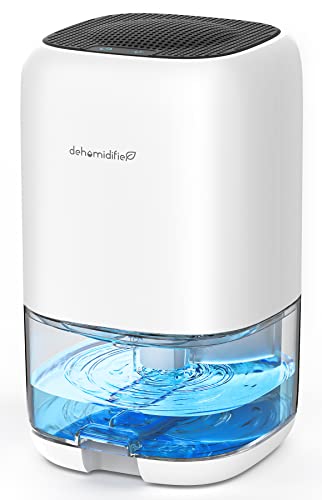
Only for very small enclosed spaces. Mini units use thermoelectric (Peltier) cooling instead of a compressor, which makes them near-silent but removes a fraction of the water — a matter of ounces per day rather than pints. They are closet appliances, not room appliances.
This is the most common purchase regret in the bedroom category, and it comes from an entirely reasonable misreading. The units are marketed for bedrooms, they are quiet, and they are cheap. What is not obvious on the box is the order-of-magnitude gap in water removal between a Peltier module and a compressor. In a wardrobe, a gun safe, a caravan or a small windowless bathroom, that small capacity is genuinely sufficient. In an actual damp bedroom, it is not.
The other quiet limitation is temperature. Thermoelectric units rely on a small temperature difference across a solid-state module, and they lose what little capability they have as the room gets cooler — the exact conditions in which condensation problems appear. If the bedroom has visible morning condensation or mildew on a wall, a mini unit will not fix it, and a properly sized compressor unit will. The general comparison between technologies is set out on our dehumidifiers hub.
How loud is a bedroom dehumidifier at night?
Quieter than people fear at a steady state, but the problem is not the steady level — it is the change. The fan hum fades into the background; the compressor kicking in and out at 3am is what wakes light sleepers. A unit that cycles less often disturbs less.
That is a useful reframing when comparing specifications, because a decibel figure only describes the constant noise floor. What matters in a bedroom is how abrupt the transitions are and how often they happen. Buying a unit with enough capacity that it reaches setpoint and stays there for long stretches produces fewer transitions than an undersized unit toggling every few minutes.
Practical features that owners consistently rate: a sleep or night mode that drops the fan and fully turns off the display rather than dimming it, a defeatable beep on the control panel, and a full-tank alarm that is a light rather than a repeating chirp. Placement helps too — on a hard floor, a unit transmits vibration into the structure, so a rubber mat under it takes the edge off both the hum and the compressor start.
Will a dehumidifier make the bedroom warmer?
A compressor unit will, slightly. It is a heat pump that discharges its waste heat back into the same room, and condensing water releases heat as well. The air will feel drier and more comfortable, but the thermometer will read a little higher, not lower.
In winter that is a non-issue and arguably a small bonus. In an upstairs bedroom in August it is a real trade-off, and it is why some households conclude that running the air conditioner is the better answer in high summer — an air conditioner dehumidifies as an inherent side effect of cooling, doing both jobs at once. The dehumidifier earns its place in the shoulder seasons and in rooms without air conditioning, where the air is clammy but not hot enough to justify cooling.
Where does bedroom damp usually come from?
Occupant respiration overnight, drying laundry indoors, an en-suite without working extraction, and cold external walls behind furniture. Morning window condensation and dark spotting in the corner of an outside wall are the two signatures worth learning to read.
The wall-behind-the-wardrobe pattern is worth calling out because a dehumidifier alone rarely fixes it. Mildew grows there because the wall surface is cold and there is no air movement across it — the room average can be perfectly acceptable while that one surface sits at the dew point. Pulling furniture a few inches off external walls so air can circulate behind it usually does more than another appliance would.
Drying laundry on a rack in a closed bedroom is the other big one, and it is entirely self-inflicted: every liter of water in those clothes ends up in the room air. If that is the source, either dry elsewhere or accept that the dehumidifier will run hard. Because bedroom air quality involves more than moisture, it is worth reading this alongside our broader guide to improving indoor air quality.
Tank or hose in a bedroom?
Usually the tank, because most bedrooms have no drain to run a hose to. That makes tank capacity and a reliable auto-shutoff more important here than in any other room — a unit that fills and stops at 2am is a unit that did half a night's work.
Given the modest moisture load, a bedroom unit generally will not fill a tank overnight the way a basement unit does, so daily emptying is realistic. Choose a tank you can carry to a bathroom without slopping — a proper handle and a splash lid sound trivial until you have done it fifty times — and check that the full-tank indicator is visible from the doorway rather than only from directly above.
Where a bedroom does have an en-suite, running a short hose to the shower drain or a floor waste is worth doing if the geometry allows it, remembering that gravity drainage needs the drain point below the outlet. Whichever route you take, set a sensible target rather than the lowest number the panel offers. Chasing an unnecessarily dry room keeps the compressor cycling all night for no comfort gain. The comfortable band described in our guide to your home's indoor climate would let it settle and stay quiet instead.
What types of bedroom dehumidifiers are there?
Footprint and drainage split bedroom dehumidifiers into a few clear formats.
Compact dehumidifiers for a small room
A compact dehumidifier suits a small room where a full-size basement unit would be overkill. Pro Breeze and Vremi both build well-reviewed compact models sized for exactly this. They trade some capacity for a footprint that fits on a closet shelf.
Continuous drainage dehumidifiers
Continuous drainage lets a unit run a hose straight to a floor drain or window, skipping the daily tank-emptying most bedrooms need. hOmeLabs and Frigidaire both include a drain port on their mid-size models, though gravity drainage still needs the drain point below the outlet.
Quiet, low noise level models
Quiet operation and a genuinely low noise level matter more in a bedroom than raw capacity. Look for a published decibel rating at the lowest fan speed, and check owner reviews specifically for how the compressor cycles at night, not just the steady hum.
What specs actually matter for a bedroom?
Past footprint and noise, a short list of specs decides how well the unit actually holds a comfortable room.
Pints per day and square footage sizing
Capacity is rated in pints per day and should be matched to the room's square footage and its dampness level, not just its size. A typical bedroom scores low on both compared to a basement, so a modest pints-per-day rating is usually plenty.
Humidistat and relative humidity control
A built-in humidistat holds the room at a target relative humidity instead of running continuously. Set it too low and the compressor cycles all night for no comfort gain — the goal is a comfortable band, not the driest number on the dial.
Water tank, auto shut-off and ENERGY STAR efficiency
Water tank capacity and a reliable auto shut-off matter most in a bedroom with no drain, since a full tank stops the unit mid-cycle. ENERGY STAR-certified models from Frigidaire and hOmeLabs use meaningfully less power per pint removed than uncertified units.
Mold, musty odor and energy efficient running cost
Mold and musty odor in a bedroom usually trace back to a cold external wall or drying laundry indoors, not the dehumidifier itself. An energy efficient unit run continuously at a sensible target costs less over a season than one cycling hard against a setting that's too low, and the EPA's guidance on indoor moisture backs holding a steady, moderate level rather than chasing the lowest reading.
Everything here is drawn from aggregated real owner reviews, manufacturer specifications and the complaint patterns that repeat across brands — never from us buying and running a unit ourselves. Our How We Rank page explains that methodology in full.


