


Affiliate Disclosure
Some links on this page are affiliate links. As an Amazon Associate, we earn from qualifying purchases — at no extra cost to you. We do not buy, test, or physically handle the products we cover; our rankings come from aggregated owner reviews, ratings and expert consensus. Commissions never change our verdicts. How we rank & full disclosure.
A window fan is a ventilation device, not a cooling appliance, and that distinction decides whether people love it or return it. Sitting in the window opening, it doesn't stir the room's existing air — it exchanges it, pushing indoor air out or pulling outdoor air in. On a cool evening after a hot day, that exchange does more for how a house feels than any freestanding fan can.
Should a Window Fan Blow In or Out?
It depends on which side of the house it's on. Put an intake fan in a window on the cool, shaded side and an exhaust fan on the warm or downwind side. Air then travels through the house in one direction, which cools far more effectively than either fan alone.
This is the technique the category exists for, and it's why most units are reversible. A single fan in a single window still works, but the effect is much stronger with a deliberate path across the house.
Intake, exhaust and cross breeze
Exhausting from the room that gets the most afternoon sun, and drawing in from the shaded side, pulls a cross breeze through the rooms in between. Exhausting from a kitchen or bathroom also removes moisture and cooking heat that would otherwise spread through the house.
When Does a Window Fan Actually Cool a Room?
Only when the outdoor air is cooler than the indoor air. Check an outdoor thermometer rather than assuming — in most climates that crossover happens in the evening and holds until mid-morning. Running the fan outside those hours imports heat rather than removing it.
Homes store heat through the day and release it at night, which is why a house can feel hotter than outdoors by late evening. A window fan exploits exactly that gap.
Thermostat control and air exchange
A built-in thermostat automates the decision, switching the fan on once the room exceeds a set temperature and off again as it drops. That's the fastest way to get a genuine air exchange without babysitting the outdoor thermometer yourself.
Will It Fit and Stay in Your Window? Twin and Dual Blade Designs
Most window fans are built for double-hung windows and use sliding side panels to fill the remaining width, with the sash lowered onto the frame to hold it. Twin and dual blade models let you run one blade in and one out at the same time.
Measure the opening width and height before buying, and check the depth of the sill. The expander panels on most units cover a defined range — beyond it you're improvising with foam board or plywood, which affects both sealing and security.
Weather resistant sealing and reversible airflow
Few window fans are genuinely weather resistant, so rain blowing into a partly open window will reach the unit during a storm — worth switching off rather than leaving running. Reversible airflow is the core feature that makes independent blade switching useful in the first place, letting a single twin-blade unit do the work of two single fans.
Does a Window Fan Bring In Pollen and Ventilation Concerns?
Yes, when it's running as an intake. Any fan drawing outdoor air in brings whatever is in that air with it — pollen, dust and wildfire smoke — because window fans have no meaningful filtration.
For an allergy-sensitive household, running the fan in exhaust mode instead of intake is the practical workaround. Ventilate when outdoor air is clean, and filter indoor air with a proper purifier when it isn't — see our guide to improving indoor air quality for when opening the house helps and when it makes things worse.
How Much Airflow and Noise: CFM and Speed Settings
Window fans move considerably less air than a 20-inch box fan — typically a few hundred CFM up to around 1,000 for twin-blade models — because the blades are small enough to fit a window opening. Noise is moderate, and much of what owners notice is rattle rather than airflow.
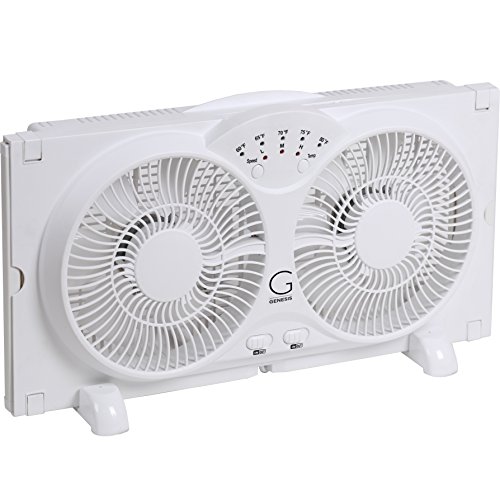
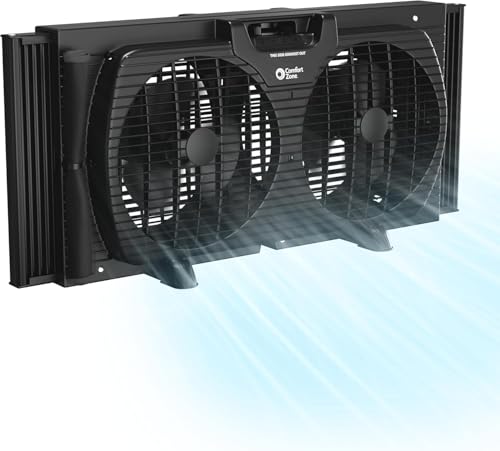
Bionaire, Holmes, Genesis and Comfort Zone all sell twin-blade models with independent speed settings for each blade, which is what makes a small-scale cross-flow through a single window possible.
Quiet operation and running cost
Most noise complaints trace back to installation rather than the motor — a unit that isn't level, or side panels not fully extended, lets vibration turn a quiet hum into a buzz. Snugging everything up and adding foam weatherstrip usually resolves it and improves the seal, which lowers running cost by cutting the air that leaks back around the frame.
Energy efficient use
A window fan is inherently energy efficient next to any mechanical cooling — it typically draws well under 100 watts. ENERGY STAR doesn't certify this category the way it does air conditioners, so the wattage figure on the box is the number to compare directly between models.
Whole-House Fans vs a Single Window Fan
If the whole house needs this treatment rather than one or two rooms, whole-house fans do the same intake-and-exhaust job on a much larger scale — at the cost of a permanent ceiling installation rather than a fan you can move between windows.
For most homes, though, a well-placed pair of window fans on opposite sides of the house gets close to the same result for a fraction of the cost and no installation at all. If raw airflow through a single opening matters more than sealing and reversibility, a box fan set in the same window often moves more air for less money — it just skips the features that make a purpose-built window fan worth the premium.
Every product recommendation below is ranked from aggregated real owner reviews and manufacturer specifications, never from us buying and running a unit ourselves — see How We Rank for the full methodology.