

Affiliate Disclosure
Some links on this page are affiliate links. As an Amazon Associate, we earn from qualifying purchases — at no extra cost to you. We do not buy, test, or physically handle the products we cover; our rankings come from aggregated owner reviews, ratings and expert consensus. Commissions never change our verdicts. How we rank & full disclosure.
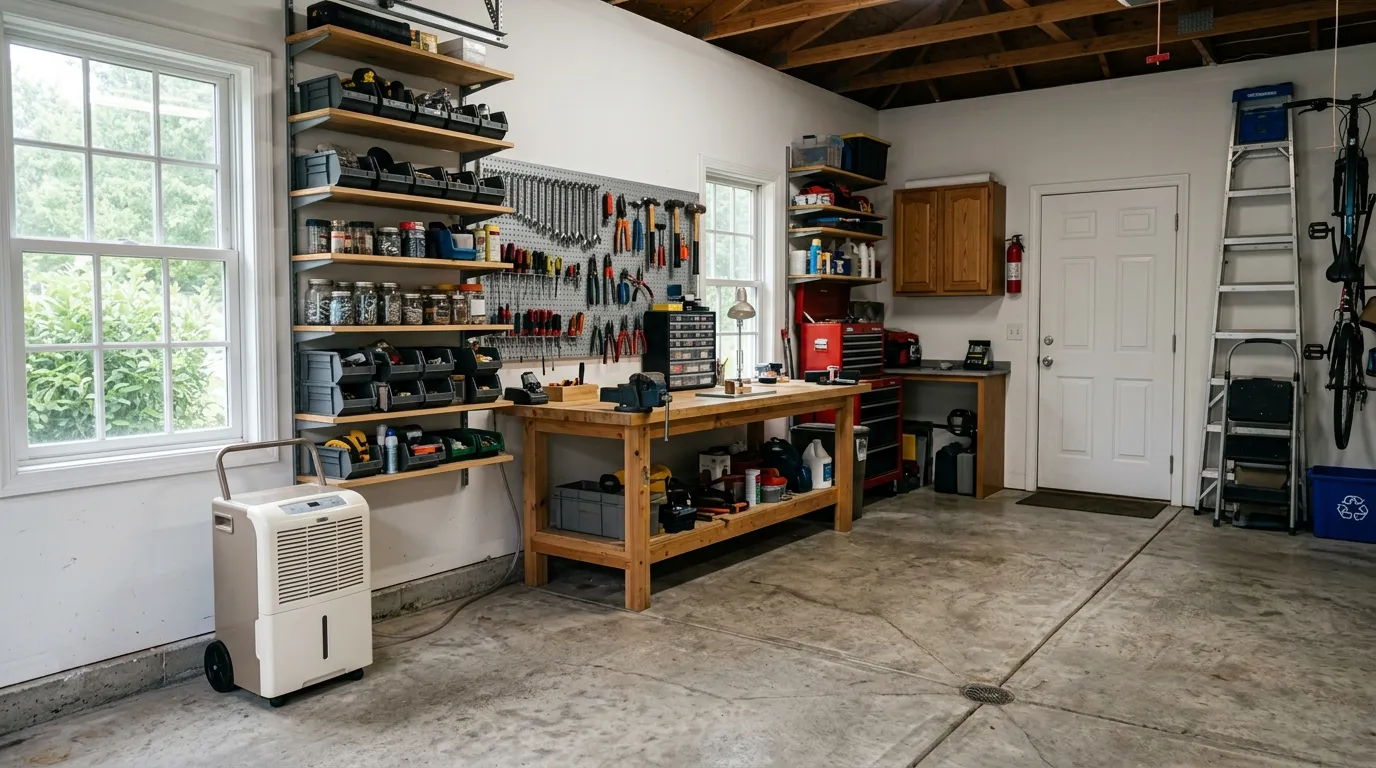
A garage breaks most of the assumptions a dehumidifier is designed around. It is unheated, usually uninsulated, sealed badly enough that outdoor air moves through it freely, built on a slab that wicks moisture up from the ground, and periodically has a soaking wet car parked in it. That combination is why so many garage dehumidifiers underperform: the appliance is not faulty, it is simply the wrong specification for the conditions.
Why do most dehumidifiers struggle in a garage?
Because standard units are compressor machines optimised for heated indoor rooms. They condense moisture on a chilled coil, and as ambient temperature falls that coil frosts over. Below roughly 40°F most consumer compressor units remove very little water regardless of what the display says.
Low temperature, compressor coils and auto defrost
Compressor efficiency and low temperature air are simply at odds. To pull moisture out of 45°F air, the coil has to sit below freezing, at which point ice accumulates, airflow chokes, and water removal collapses. Auto defrost mitigates it by pausing the compressor and running the fan to melt the ice, but every defrost cycle is time not spent removing moisture. In a genuinely cold garage a unit can spend more of its life defrosting than working.
There is a second cold-weather issue owners often discover the hard way: water freezing in the tank or drain hose. Almost every manufacturer publishes a minimum operating temperature in the manual, and running below it can damage the unit as well as simply achieving nothing. In an unheated garage that dips below freezing, plan to either drain the system and shut it down for winter or use a machine designed for the temperature.
Compressor or desiccant for an unheated garage?
Compressor if the garage stays reasonably warm year-round and you mainly need summer dehumidification. Desiccant if it runs cold. A desiccant unit absorbs moisture onto a rotor and regenerates it with heat, so low temperature does not defeat it the way it defeats a coil.
Energy efficient desiccant vs compressor running cost
Desiccant units have three practical advantages in a garage: they keep working near freezing, they discharge slightly warmed dry air which helps surfaces dry out, and they tend to be lighter and quieter because there is no compressor. The trade-off is electricity. Regenerating the rotor uses a heating element, so an energy efficient rating is harder to hit — power consumption per pint removed is higher than a compressor unit achieves in warm conditions.
That trade-off flips with the seasons, which is why the honest recommendation depends on your climate rather than on a universal winner. In a mild region where the garage rarely drops below 60°F, a compressor unit with auto defrost, like the ones Frigidaire and hOmeLabs both sell, is the cheaper machine to run. In a region with real winters, a compressor unit is idle exactly when you need corrosion protection most. The underlying comparison is covered in more depth on our dehumidifiers hub.
How do you size a dehumidifier for a garage?
Treat the garage as one dampness category worse than it looks, then size up again for air leakage. Square footage tables assume an enclosed conditioned room; a garage with a gappy door and no insulation is continuously exchanging air with outdoors, so the effective load is far higher.
Square footage, pints per day and coverage
Buy toward the top of the pints per day rating and the top of the stated coverage range rather than the middle, since a garage rarely matches the enclosed-room conditions those numbers assume. The other load nobody accounts for is the car. A vehicle driven in during rain or snow carries a genuinely large amount of water on its body, in the wheel wells and on the underside, and effectively all of it evaporates into the garage over the following hours. A household that parks two wet cars indoors every day is asking the dehumidifier to handle a repeating moisture event, not a steady background level.
Add anything else that generates moisture: a chest freezer sweating in summer, damp firewood, a laundry area, or a slab with no vapor barrier under it. All of it argues for capacity headroom. As in every other room, an undersized unit that runs continuously and never reaches setpoint costs more to run than the larger unit that cycles.
How do you drain a dehumidifier in a garage?
Usually the easiest room in the house for this. Many garages have a floor drain, and where they do not, a drain hose can often run out under the door or through a wall. Gravity drainage needs the drain point below the outlet, so raise the unit on a bench or blocks.
Relying on the tank in a garage is not realistic. The space is large, the moisture load is high, and nobody checks a garage as often as a living room — the practical outcome is a full tank, an auto-shutoff, and weeks of the unit sitting idle while the tools quietly corrode. Set up continuous drainage on day one.
Drain hose freezing and condensation risk
The freezing caveat applies to the drain hose as well as the tank. A drain line run outdoors through a wall will freeze solid in winter, back up, and stop the unit — and the condensation that collects at the blockage can do its own damage. Where that is a risk, route the hose to an interior floor drain instead, keep the run short and sloped, and check it seasonally for kinks, crushing under stored items, and algae growth inside the line.
Does a dehumidifier stop rust and musty odor in a garage?
It substantially slows corrosion, which is why workshops care about it — steel rusts far more readily above roughly 50–60% relative humidity. It also stops new mold and mildew growth, but it does not remove existing colonies or the smell they already produced.
Rust, relative humidity and a humidistat target
Keeping relative humidity down, checked against a humidistat rather than by feel, is the single most effective, lowest-effort thing you can do for hand tools, a tool chest, machinery and a car body stored indoors. It is the reason a dehumidifier is standard equipment in a serious home workshop. The protection is continuous rather than dramatic — nothing visibly happens, which is precisely the point.
The musty odor question is different. That smell comes from mold and mildew already growing on porous stored items — cardboard boxes, fabric, old carpet, untreated timber, paper. Dropping the humidity stops the growth, but the existing colonies and the residue still have to be cleaned out or thrown away. Owners who lower the humidity and expect the musty odor to disappear on its own are usually disappointed; owners who clear out the wet cardboard at the same time are not.
What else has to happen before the dehumidifier can win?
Seal the obvious leaks first. A dehumidifier running with the garage door open, or against a half-inch gap under a warped door, is dehumidifying the neighbourhood. Weatherstripping, a decent door seal and a vapor barrier under stored items do more per dollar than extra capacity.
ENERGY STAR ratings and condensation prevention
Air sealing is the highest-value preparation because every cubic foot of humid, damp outdoor air that leaks in is moisture the machine has to remove again. A bottom seal on the garage door, weatherstripping around the service door, and closing off gaps where the wall meets the slab are cheap and permanent. Insulation, where it is practical, further reduces both the moisture load and the temperature swing that causes condensation on cold metal surfaces in the first place. An ENERGY STAR-certified unit from a brand like BaseAire or Aprilaire also removes more moisture per kilowatt-hour, which matters once the air sealing is done and the machine is doing real work rather than fighting open air.
Then be realistic about the target. There is no benefit in driving a garage to the low thirties, and no unit will get there against that much air leakage anyway. Aim for the same sensible band as the rest of the house — the reasoning is set out in our guide to the ideal indoor humidity level — and let the unit cycle rather than run permanently. If the garage shares a wall with a damp basement, treat the two spaces together rather than separately; the basement dehumidifier considerations frequently apply to both.
Every judgment above comes from aggregated real owner reviews, manufacturer specifications and the failure patterns that repeat across brands and price points — we do not buy or run the units we cover. Our How We Rank page sets out that methodology in full.